BOOKS THAT INSPIRE
The 7 Habits of Highly Effective People
by Stephen R. Covey
THE 7 HABITS OF HIGHLY EFFECTIVE PEOPLE is a powerful self-improvement book written in 1989 by Stephen R. Covey. For those of us looking for ways to increase personal effectiveness in our quest for greater success and greater happiness, this book is a ‘must-read’.
Highlights
- Real change starts from within you. If you really want to improve your situation, work on the one thing over which you have control – yourself.
- Communication is the most important skill in life. Lasting success is only possible if you make meaningful connections with others.
- Take time to renew yourself. Keep learning, practicing, growing. Our behaviour is a product of our decisions, not our conditions.”
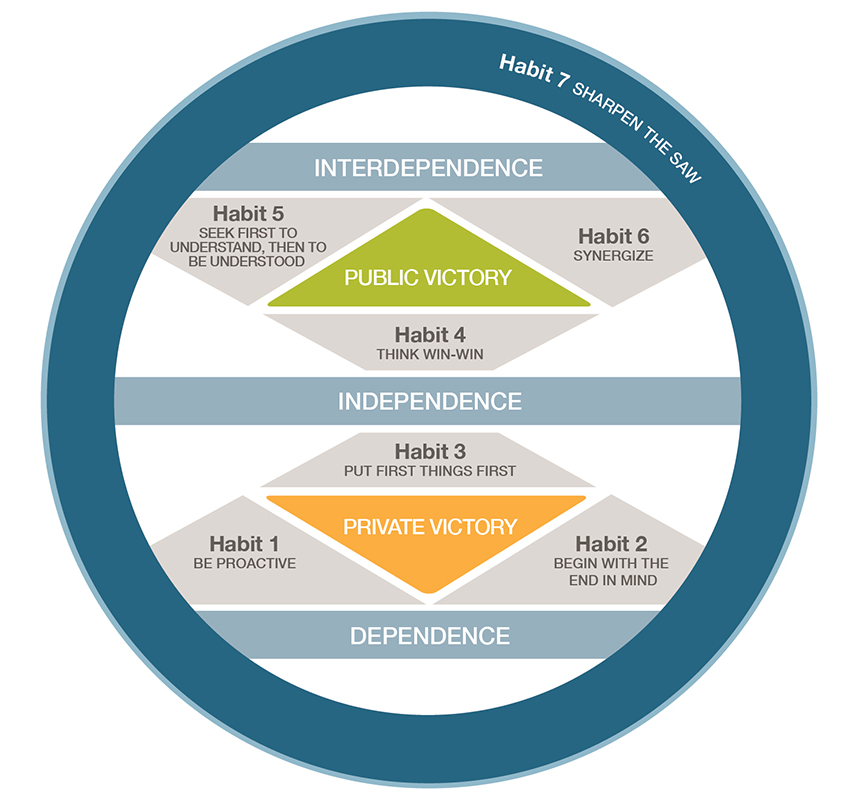
The author expresses the ‘action plan’ in the following structured model of development.
We are embarking on a series to discuss one of the 7 Habits over the next few weeks. Having started with the first habit, we now share our insights on Habit 2.
Feel free to contact us at info@bellanmedia.co.za should you wish to comment or contribute.
Habit 1: Be proactive
Being proactive involves taking responsibility for our choices, and using one’s initiative to get things done. It is about understanding your ‘circle of influence’, and coming to terms with what is within and/or beyond your reach.
To activate proactivity, one must firstly commit to move from dependence to independence. Start by changing your thinking from “if only I can be …” to “I am …”. The more positive energy you give, the more your ‘circle of influence’ will expand. Through this, one becomes the architect of one’s own life and consequently ‘master’ of one’s own effectiveness.
Knowledge of Habit 1 is fundamental to self-improvement, and forms the basis for almost any activity in life.
Habit 2: Begin with the end in mind
This is the habit of vision, objectives, and destination.
Beginning with the end in mind means that you visualize in rich detail the result of your action prior to starting a task or project, allowing you to isolate your objective and target what is priority or what really matters to you.
Adopting Habit 2 is an immediate plus in your own life, as you start with a clear destination as well as continue to improve the quality of your decision-making.
Habit 3: Put first things first
This habit has to do with assessing, integrity, and intention.
Establish what needs to be done, exercise discipline, and stick to your agreements. Plan your day-to-day actions based on what is most important vs what is most urgent.
Habit 3 is about focusing on your goals and exercising willpower to stay on track. As the author eloquently puts it, “The key is not to prioritize what’s on your schedule, but to schedule your priorities”.
Mastery of this skill means that one can shape one’s life by working pro-actively and setting the right priorities. This is the second big step to independence, while on our way towards inter-dependence.