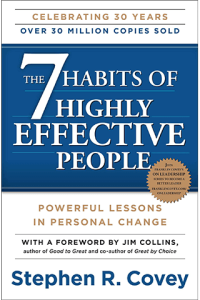
Books that shook the business world: The 7 Habits of Highly Effective People by Stephen R Covey
PADDY PADAYACHEE
THE 7 HABITS of Highly Effective People is a powerful self-improvement book written in 1989 by Stephen R Covey. For those of us looking for ways to increase personal effectiveness in our quest for greater success and greater happiness, this book is a ‘must-read’.
Highlights
- Real change starts from within you. If you really want to improve your situation, work on the one thing over which you have control – yourself.
- Communication is the most important skill in life. Lasting success is only possible if you make meaningful connections with others.
- Take time to renew yourself. Keep learning, practicing, growing. Our behaviour is a product of our decisions, not our conditions.”
The author expresses the ‘action plan’ in the following structured model of development.

1.Be proactive
Being proactive involves taking responsibility for our choices, and using one’s initiative to get things done. It is about understanding your ‘circle of influence’, and coming to terms with what is within and/or beyond your reach. To activate proactivity, one must firstly commit to move from dependence to independence. Start by changing your thinking from “if only I can be …” to “I am …”. The more positive energy you give, the more your ‘circle of influence’ will expand. Through this, one becomes the architect of one’s own life and consequently ‘master’ of one’s own effectiveness. Knowledge of Habit 1 is fundamental to self-improvement, and forms the basis for almost any activity in life.
2. Begin with the end in mind
This is the habit of vision, objectives, and destination. Beginning with the end in mind means that you visualize in rich detail the result of your action prior to starting a task or project, allowing you to isolate your objective and target what is priority or what really matters to you. Adopting Habit 2 is an immediate plus in your own life, as you start with a clear destination as well as continue to improve the quality of your decision-making.
3. Put first things first
This habit has to do with assessing, integrity, and intention. Establish what needs to be done, exercise discipline, and stick to your agreements. Plan your day-to day actions based on what is most important vs what is most urgent. Habit 3 is about focusing on your goals and exercising will power to stay on track. As the author eloquently puts it, “The key is not to prioritize what’s on your schedule, but to schedule your priorities”. Mastery of this skill means that one can shape one’s life by working pro-actively and setting the right priorities. This is the second big step to independence, while on our way towards inter-dependence.
4. Think win-win
According to Covey, Habit 4 is the first step to inter-dependent relationships. There is always the tendency to think in terms of winning or losing, or wanting to be right. This habit deals with the apparent contradiction – for every winner, there can also be another winner. In order to become ultimately successful, the trick is to realise that you can accomplish a lot more by seeking the cooperation of others, and treating them well. To give and receive love, and to feel successful one needs the ‘other’ person’s buy-in. We must commit to creating win-win situations where we adopt an ‘abundance mentality’, or the belief that there is enough for everyone so that each party feels satisfied. The concepts of giving and acting fairly without restraint is an example of good interpersonal leadership. It liberates us to a healthier work environment that is mutually beneficial to all, and in which there are no losers.
5. Seek first to understand, then to be understood
No meaningful solution can arise from a lack of (or absence of) understanding. Therefore, Habit 5 emphasises that we must seek first to understand, then to be understood. Before we can offer advice, suggest solutions, or effectively interact with another person in any way, we must seek to deeply understand them and their perspective through empathic listening. A quote from the author explains this concept most succinctly: “You have to build the skills of empathic listening on a base of character that inspires openness and trust.” The second part of Habit 5, “… then to be understood”, hinges on one’s deep understanding of the other person’s needs and concerns, and one’s personal credibility which was built over time – and one can only gain understanding by listening.
6. Synergize
When you communicate synergistically, you are simply opening your mind, heart, and expressions to new possibilities, new alternatives, and new options. Synergy involves teamwork, team building, and the development of unity and creativity with other human beings. The more genuine the involvement, the more sincere and sustained the participation in analysing and solving problems, the greater the release of everyone’s creativity, and their commitment to what they create. Once people have experienced real synergy, they are never quite the same again. This is arguably the essence of the power in the Japanese approach to business, which has changed the world marketplace. The possibilities of truly significant gain – and of significant improvement – are so real that it’s worth the risk that such openness in communication entails.
7. Sharpen the saw – principles of balanced self-renewal
“I don’t have time to sharpen the saw,” the man says emphatically. “I’m too busy sawing!” Habit 7 is therefore about taking time to sharpen the saw. In other words, it’s about preserving and enhancing the greatest asset you have – you.
In this habit, we focus on renewing the four dimensions of life:
- Physical: Exercise, nutrition, stress management
- Social / emotional: Interpersonal leadership, empathy, synergy, creative co-operation
- Mental: Reading, visualizing, planning, writing
- Spiritual: Value clarification and commitment, study and meditation
‘Sharpen the saw’ basically means getting to grips with all four motivations. To do this, we must be proactive, taking time to sharpen the saw without distractions. It means exercising all four dimensions of our nature, with enthusiasm, and simultaneously… until it becomes a kind of healthy addiction.
Because it’s at the centre of our Circle of Influence, no one can do it for us. We must do it for ourselves. This is the single most powerful investment we can ever make in investment in ourselves, using the only instrument we have, to deal with life and to contribute meaningfully.
Finally …
‘Ecology’ is a word that describes the synergism in nature – everything is related to everything else. It is in this relationship that creative powers are maximised. Similarly, the real power in these Seven Habits’ lies in their relationship with each other, rather than just in the individual habits themselves.
Paddy Padayachee, business development director, Bellan Media.
Options for ‘Moment of Truth’
“We are what we repeatedly do. Excellence, then, is not an act, but a habit.” – Aristotle
“Courage is what it takes to stand up and speak; courage is also what it takes to sit down and listen.” – Winston Churchill