Which boxes to complete, where to get the information, and what records you need to keep
A TRAVEL ALLOWANCE can be a valuable tax benefit for employees who use their own vehicles for work purposes. However, many taxpayers either fail to claim what they are entitled to or make mistakes that result in SARS rejecting their claims.
Understanding the rules, and maintaining the correct records, can make a significant difference to your tax outcome.
The first point to understand is that a travel allowance is not a tax-free payment. Instead, it is an allowance paid by your employer to compensate you for using your private vehicle for business travel.
The allowance is reflected on your IRP5, and is taken into account when your annual tax return is assessed. You may then claim a deduction for the business portion of your travel, provided you meet the SARS requirements.
Who can claim?
Generally, you may qualify to claim a travel deduction if:
- You receive a travel allowance from your employer;
- You receive a taxable reimbursive travel allowance;
- You use your own vehicle for business travel; or
- You maintain a valid logbook recording your business kilometres.
If your employer reimburses you at the SARS prescribed rate under the non-taxable reimbursement rules, no deduction is available because the reimbursement itself is not taxable.
Keeping a proper logbook
The most important document supporting a travel claim is your logbook. Without one, SARS will generally not allow a deduction – regardless of how much business travel you have undertaken.
Your logbook should include the following:
- Opening odometer reading at the beginning of the tax year;
- Closing odometer reading at the end of the tax year;
- Date of every business trip;
- Starting point and destination;
- Purpose of the trip; and
- Business kilometres travelled.
You do not have to record every private trip, but SARS needs enough information to calculate the total business kilometres travelled during the tax year. Your opening and closing odometer readings, together with your logbook showing your total business travel, is sufficient to determine your private travel.
If you use more than one vehicle for business purposes, you must keep a separate logbook for each vehicle.
Business travel versus private travel
One of the most common mistakes is claiming ordinary commuting between home and your normal workplace. SARS regards this as private travel, and it cannot be claimed.
Examples of business travel include:
- Visiting clients.
- Travelling between different business premises.
- Attending meetings at another office.
- Visiting suppliers.
- Travelling to temporary work sites.
Driving from home to your regular office in the morning and back home in the evening is private travel, even if your employer pays you a travel allowance.
Since the ordinary meaning of the term ‘regular office’ would refer to the place you would normally carry out your work, it is suggested that if you work from home, mileage relating to any visits contemplated in the above examples of ‘business travel’ would be counted to and from your home address.
If you normally travel to a regular office but your first business visit for the day starts at home, various SARS officials have interpreted the calculation of the business component in different ways. Methods that I have encountered include the following:
- The distance from home to your first business visit would be considered as private travel. This is all well and good if such distance is similar to your normal commute, but would be absurd if (for example) your office is 10 km from home, but your first client is located 150 km away!
- The distance from home to your first business visit would be business travel to the extent that it exceeds your normal commute. This method is fair on the face of it, but could cause some raised eyebrows should an over-zealous SARS official decide to verify the distance on Google Maps.
- The distance from home to your first business visit is regarded as business travel, without any deduction for your regular commute. The argument in this case is that you are not travelling to your ‘regular office’, and is fair in that it puts you on the same footing as someone working from home.
Should SARS decide to audit your logbook, you may be called upon to prove that the distance you have claimed meets the criteria for ‘business travel’ – including the methodology used, and your reasons for using such methodology.
While there is no guarantee that the SARS official concerned will accept your particular methodology, it is in your interest to ensure that you are consistent in the methodology applied.
How is the deduction calculated?
SARS allows two methods for calculating your deductible travel expenses.
- The cost scale method
This is the simpler option. SARS publishes a cost table each year that estimates the running costs of a motor vehicle based on its value. Using your business kilometres and the applicable cost table, the deductible business portion can be calculated.
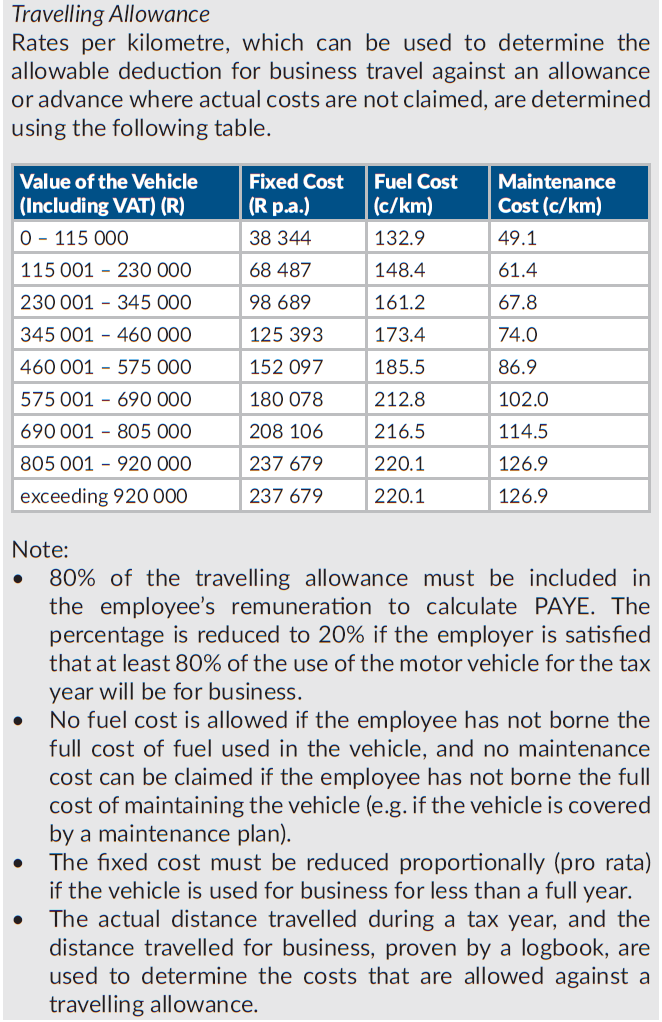
E-filing does the calculation automatically based on the value of your vehicle and the number of business kilometres travelled. However, if you are completing your 2026 tax return (for the period 1 March 2025 – 28 February 2026) and want to check SARS’ calculations, the following table is applicable:
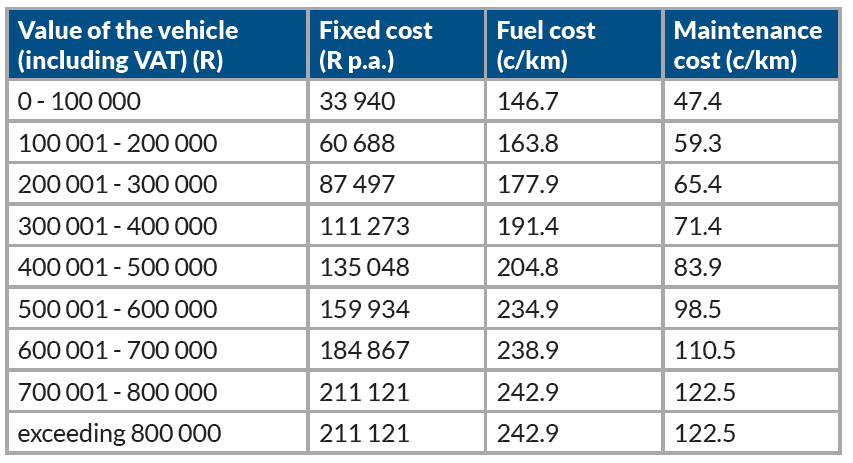
Note that the table applicable for the 2027 tax year (1 March 2026 – 28 February 2027) has been revised, and is as follows:
- The actual cost method
Alternatively, you can calculate the actual costs of operating your vehicle. This requires detailed records of your vehicle expenses, including:
- Fuel and oil.
- Repairs and maintenance.
- Insurance.
- Licence fees.
- Finance charges or lease costs.
- Wear and tear.
The business-use percentage, determined from your logbook, is then applied to these costs to calculate the deductible amount. This method requires considerably more record-keeping, but may produce a larger deduction for taxpayers with high vehicle expenses.
Note that you are entitled to use whichever method provides the greater deduction.
In my experience, the tables provide the more favourable outcome in the majority of cases, but claiming based on actual costs may work out better if your vehicle expenses (particularly maintenance) are higher than average. Unfortunately, the only way to find out is to do the sums using both methods!
Completing your tax return
When completing your ITR12 tax return, SARS will ask whether you received a travel allowance, and whether you maintained a logbook. The second question seems somewhat moot given that no claim will be entertained by SARS if a logbook is not kept, but ticking the box serves as a declaration on your part.
You will generally need to provide information such as:
- Vehicle details.
- Opening and closing odometer readings.
- Total kilometres travelled.
- Business kilometres travelled.
- The method used to calculate your claim.
The travel allowance reflected on your IRP5 should already be pre-populated on your tax return. Ensure that the information matches your IRP5 before submitting your return.
Keep your supporting documents
Although SARS does not usually require you to upload your logbook or supporting documents when submitting your return, you must retain them in case your return is selected for verification or audit.
Documents to keep include:
- Your completed logbook.
- Fuel receipts (if using the actual cost method).
- Insurance statements.
- Vehicle finance agreements.
- Repair and maintenance invoices.
- Vehicle licence documents.
These records should generally be retained for at least five years after submitting your tax return.
Common mistakes to avoid
Many travel claims are reduced or rejected because taxpayers make avoidable errors. These include:
- Not keeping a logbook.
- Claiming home-to-office travel.
- Estimating kilometres instead of recording them.
- Claiming expenses for a company vehicle.
- Forgetting to record opening and closing odometer readings.
- Using inconsistent figures that do not match the vehicle’s total annual mileage.
Accurate records greatly improve the chances of a successful claim if SARS reviews your return.
Final thoughts
A travel allowance can reduce your tax liability, but only if you comply with the SARS requirements. The key to a successful claim is maintaining a detailed and accurate logbook throughout the year, rather than trying to recreate your travel history at tax time.
If your work regularly requires you to visit clients, suppliers, or different business locations using your own vehicle, keeping proper records can translate into meaningful tax savings.
By understanding the rules, distinguishing business travel from private travel, and retaining all supporting documentation, you can confidently claim the deduction to which you are entitled while remaining fully compliant with SARS requirements.
SARS even provides a free electronic logbook that taxpayers can download and use, making it easier to keep accurate records throughout the tax year. Consistent record-keeping is far easier than reconstructing months of travel after the fact, and helps ensure that your travel claim withstands any SARS verification process.
Steven Jones is a retired tax practitioner and member of the South African Institute of Professional Accountants, and the editor of Personal Finance and Tax Breaks.